
If you want custom cabinets built for a kitchen, bathroom, or built-in office in Silicon Valley, you have more options than the two extremes most people know about: the big-box store and the online RTA warehouse. Between those sits a working layer of local manufacturers, cabinet shops, and semi-custom fabricators spread across San Jose, the Peninsula, and San Francisco. Where you buy shapes almost everything that matters later: how long you wait, how the boxes are built, and who picks up the phone when a drawer front chips two years in. This guide walks through your real local options and how to tell them apart.

The Four Places Cabinets Actually Come From
Almost every cabinet sold in the Bay Area traces back to one of four sources, and knowing which one you're dealing with tells you most of what you need to know. First, imported RTA (ready-to-assemble) cabinets: flat-packed boxes made overseas, sold online or through a local dealer who assembles them. They're the cheapest and often ship in days, but you take whatever sizes and finishes are in the catalog. Second, national semi-custom lines from brands you'll see in showrooms: factory-built in the Midwest or South, ordered through a kitchen designer, with modest size and door adjustments and a 6 to 10 week lead time.
Third, true local manufacturers: shops in San Jose, Hayward, or the East Bay that cut, assemble, and finish cabinets here in Northern California. This is where custom sizing, odd angles, and specific finishes get handled without a change-order fee for every tweak. Fourth, individual custom woodworkers and small millwork shops that build one project at a time, which is beautiful work but often carries the longest timelines and highest prices. American Built Cabinets sits in that third category: local manufacturing with roughly 3-week lead times, which is unusually fast for cabinets built to your dimensions.
Why Local Manufacturing Changes the Math
When cabinets are built within driving distance of your home, a few practical things get easier. Measurements can be verified against the actual room instead of a sketch faxed to a factory two time zones away. If a wall is out of plumb by half an inch, which is normal in older San Jose and San Francisco homes, a local shop can scribe fillers and adjust rather than shipping you a filler strip that doesn't fit. Damaged or wrong parts get replaced in days, not by reordering a container.
Local production also tends to shorten the timeline dramatically. Imported custom can run 8 to 14 weeks once you factor in ocean freight and port delays. A local manufacturer running its own CNC and finishing line can turn a full kitchen in about three weeks because there's no shipping leg and no shared factory queue on the other side of the world. For builders working to a framing or close-out schedule in a competitive Bay Area market, that difference decides whether the trades stay on site or come back twice.
How to Judge Build Quality Before You Order
Price hides a lot, so look at construction instead of the quote. Ask what the box is made of. Furniture-grade plywood (usually 3/4 inch for cases and 1/2 inch for backs) holds screws, resists moisture, and survives the occasional dishwasher leak far better than particleboard. MDF is fine and stable for painted doors and shaker panels because it won't telegraph wood grain through paint, but you don't want it as your structural box in a wet area. Solid wood belongs on face frames, doors, and drawer boxes, not on large flat panels where it can cup.
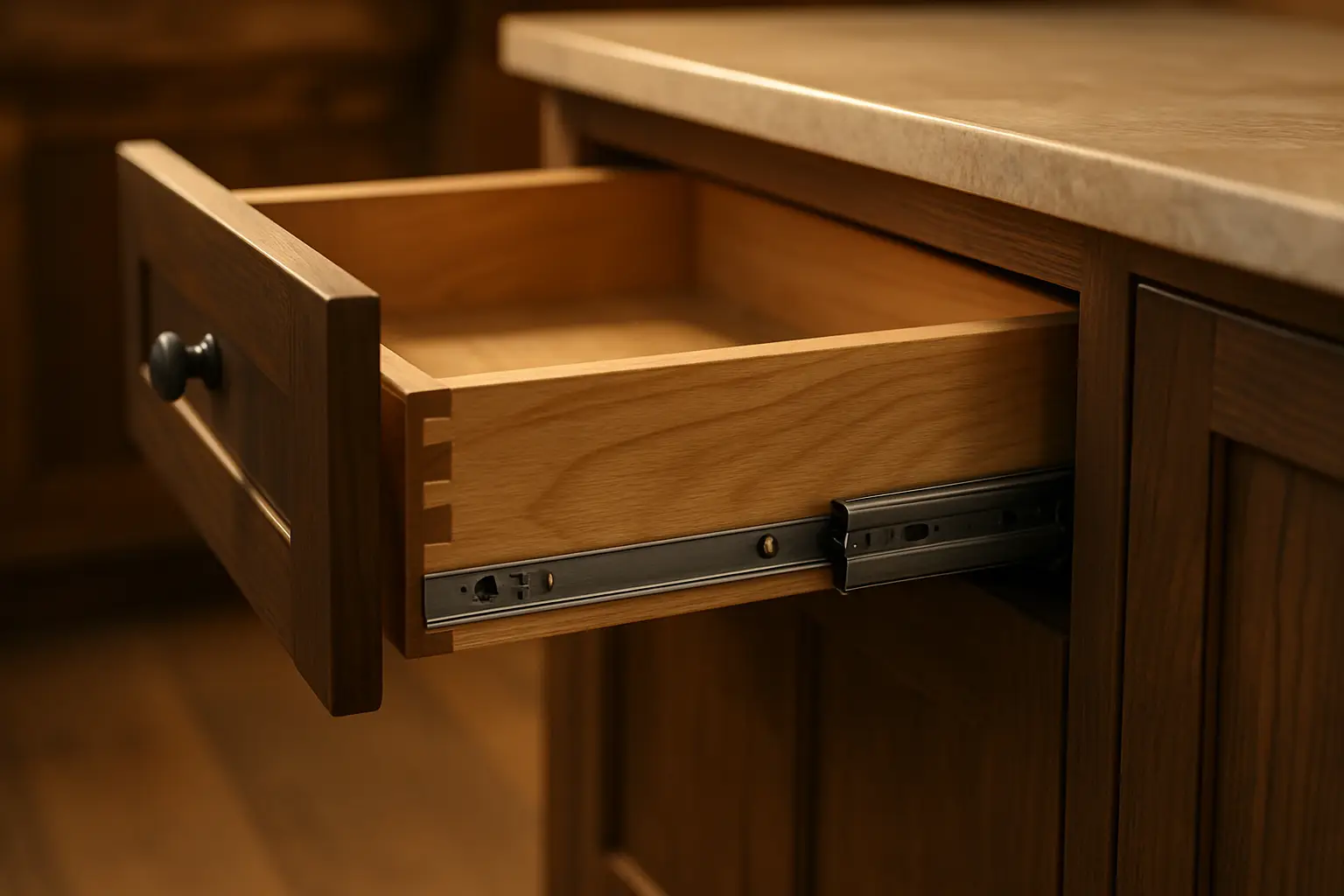
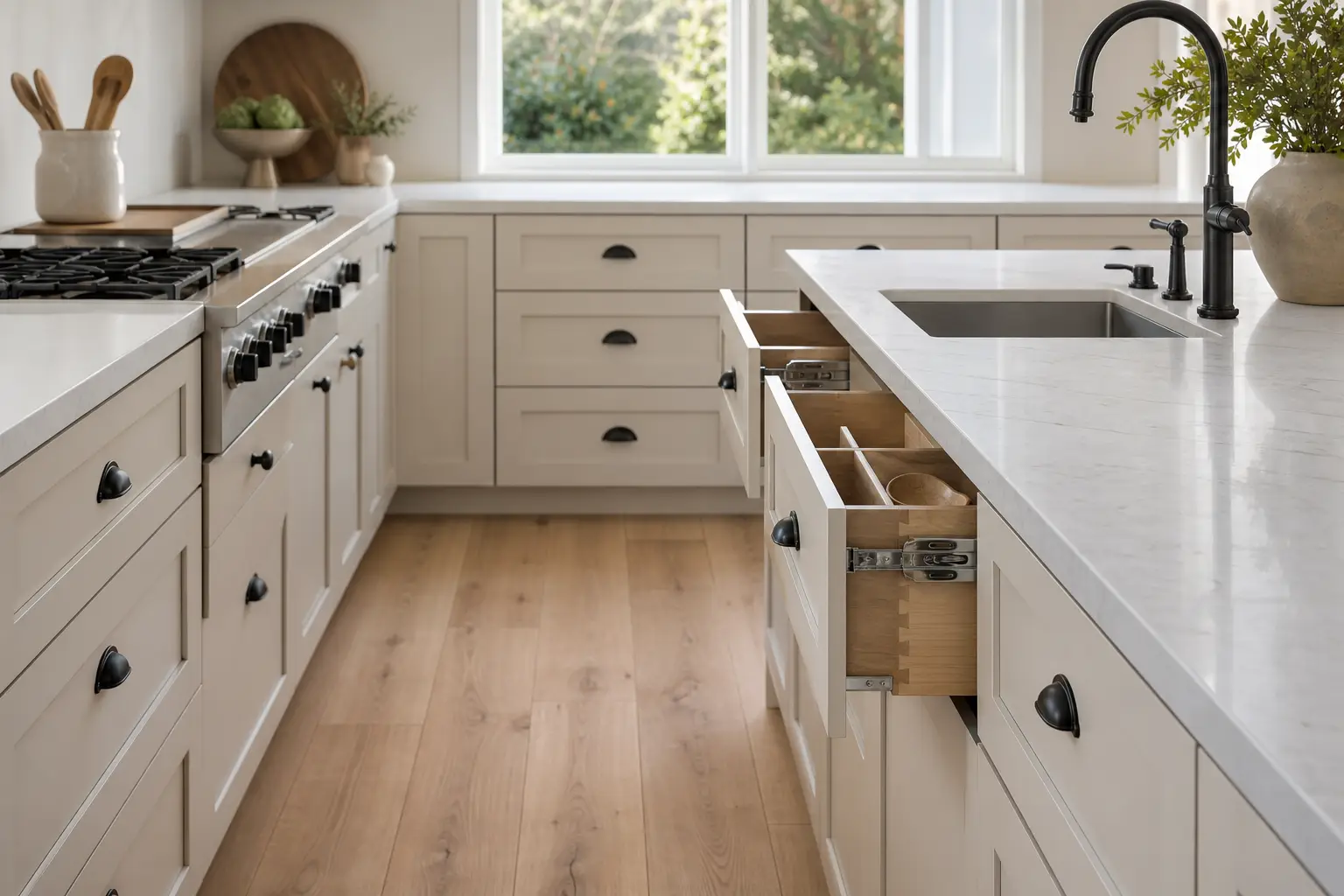
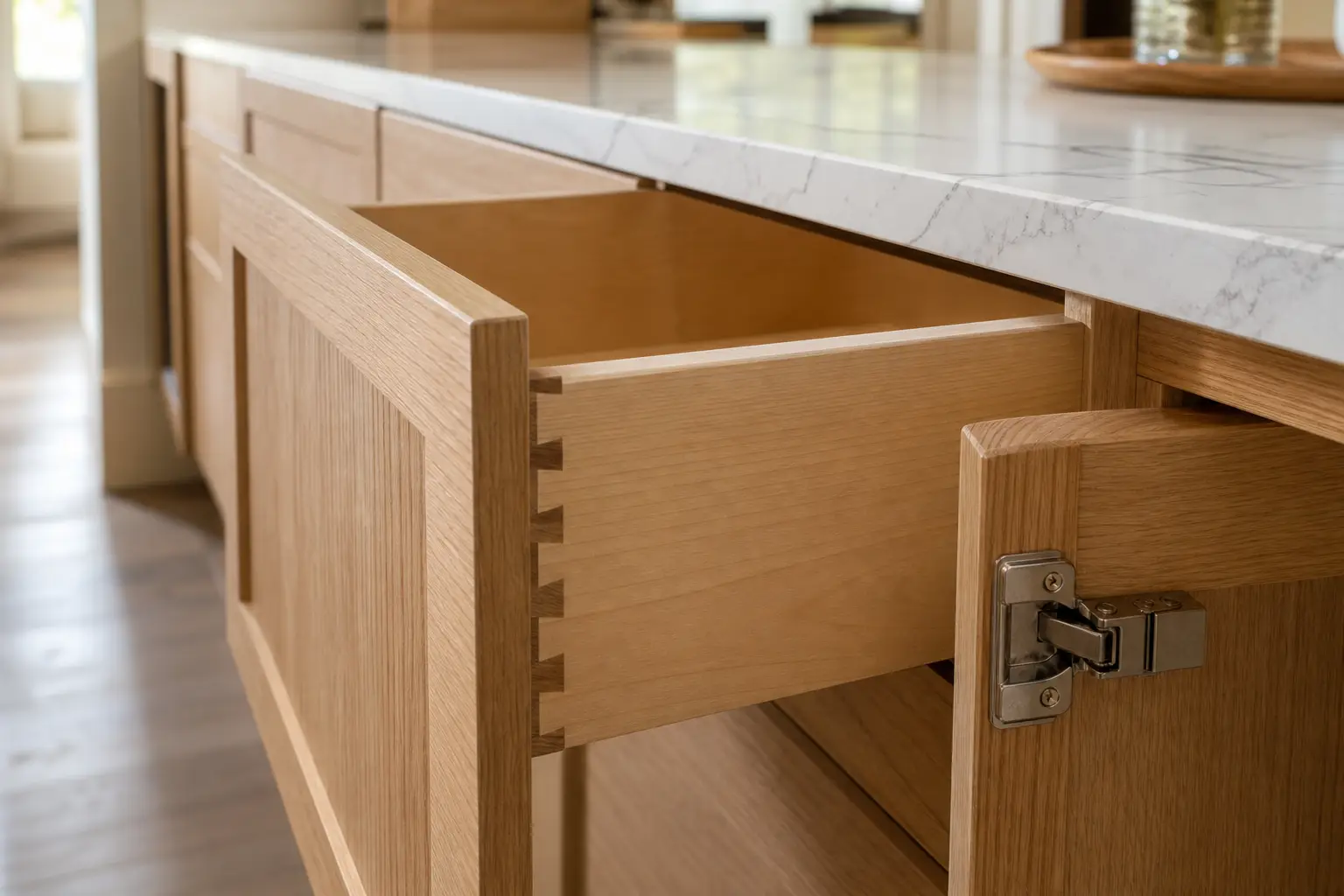
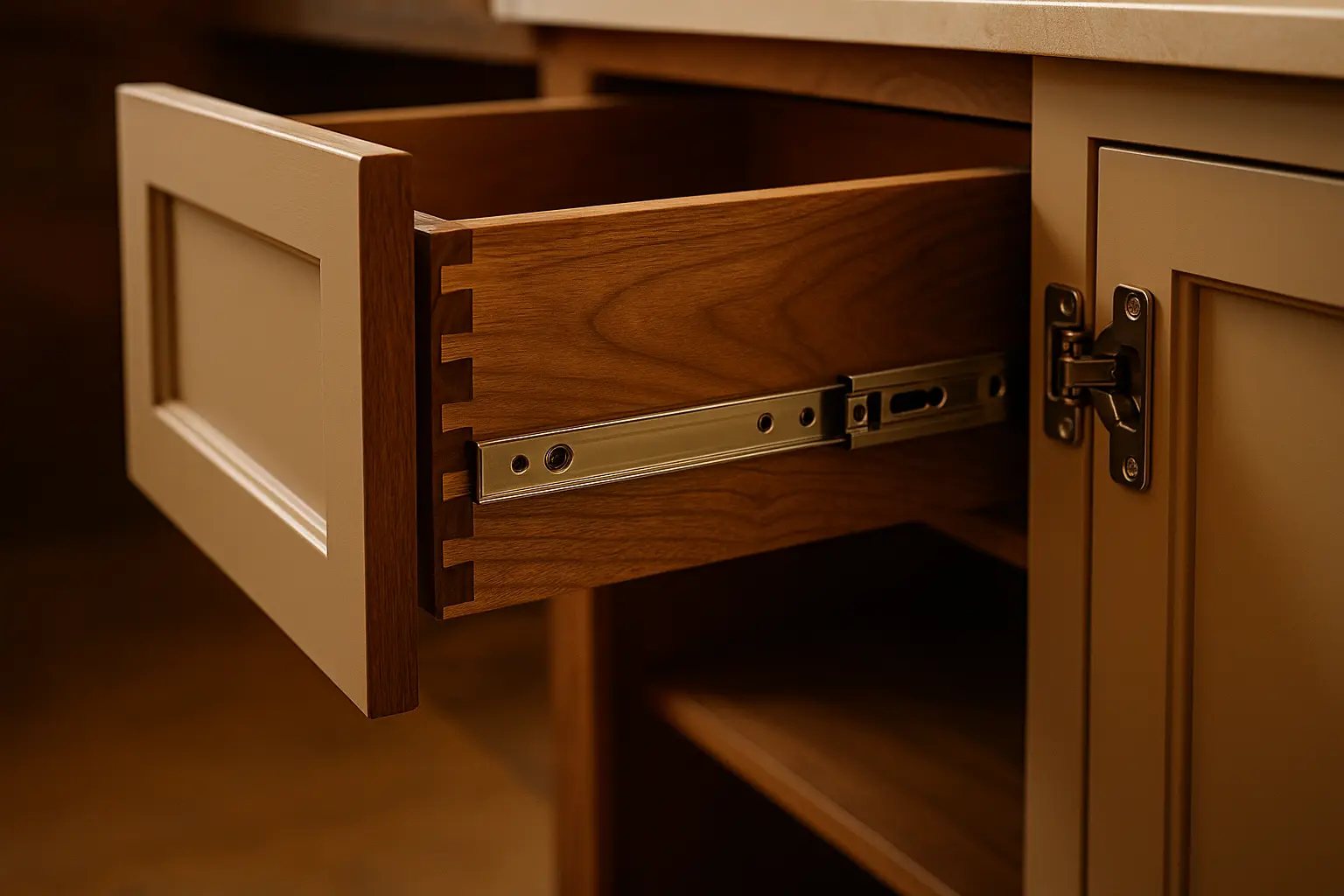
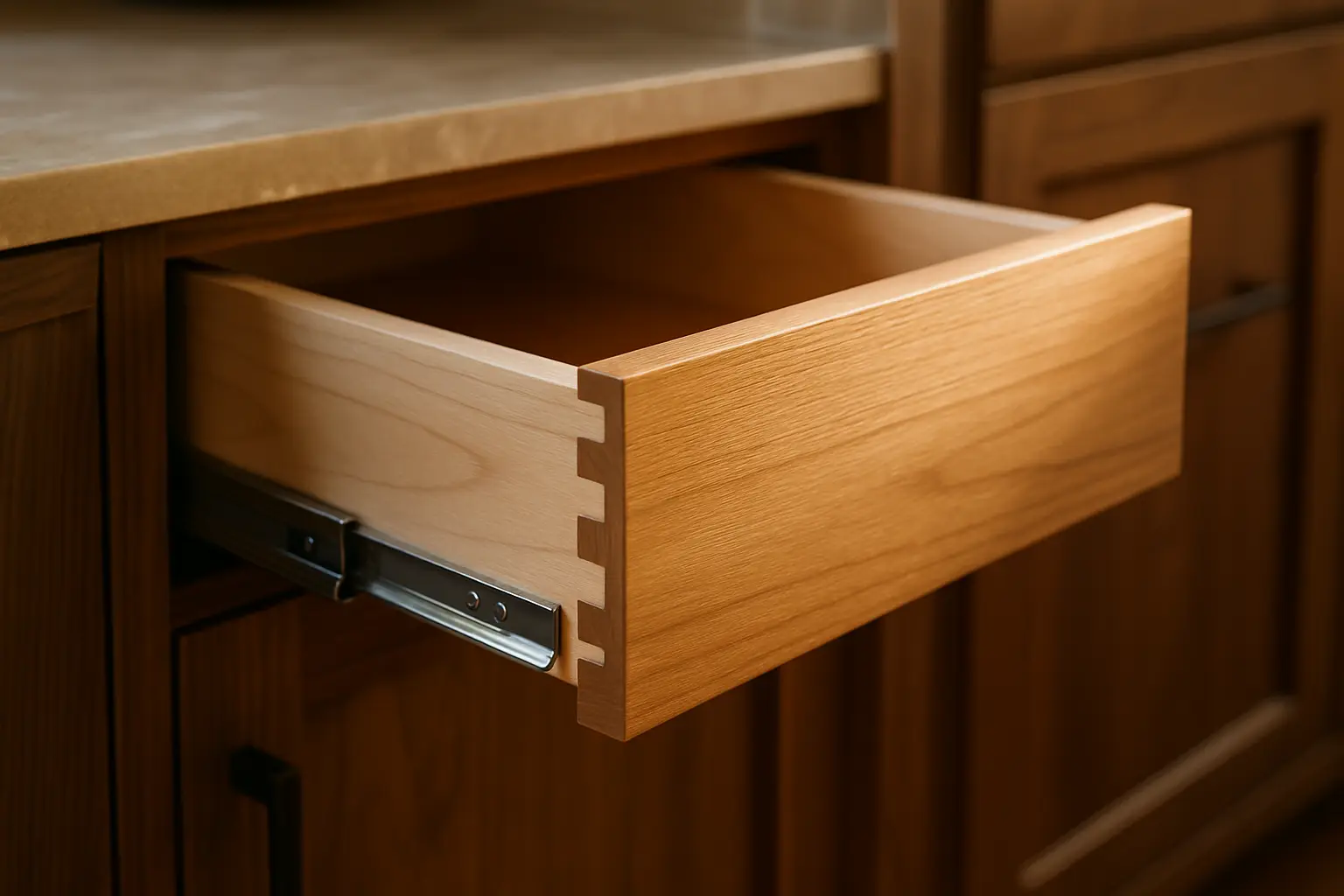
Then look at the moving parts. Dovetailed solid-wood drawer boxes outlast stapled particleboard drawers by a wide margin. Full-extension, soft-close undermount slides rated around 100 lbs let you reach the back of a deep drawer and close it without a slam. Soft-close hinges should be standard, not an upcharge. Ask about the finish: a catalyzed conversion varnish or a two-part urethane is far more durable on a kitchen than a simple lacquer, and it matters most on painted white cabinets that get handled daily. A shop that answers these questions in specifics is telling you something good.
Matching the Source to Your Project
A landlord refreshing a rental unit and a homeowner remodeling a forever kitchen should not buy from the same place. If your layout is standard, your budget is tight, and you can live with catalog sizes, RTA or a semi-custom line will serve you fine. The moment your kitchen has a 46-inch sink base, a tall pantry that has to clear a soffit, a peninsula with an angled return, or a paint color that has to match existing trim, you're in custom territory where a local manufacturer earns its keep.
Builders and designers across the Peninsula and South Bay often mix sources within one project: stock boxes where nothing is unusual, custom locally-built runs where the architecture is tricky. What matters is warranty ownership. When the manufacturer is local and stands behind the work directly, you're not chasing an offshore factory through a middleman if a door warps in year two. Ask who holds the warranty, how long it runs, and whether replacement parts are made on the same line as the originals so the finish still matches.
FAQ
Q1: How long does it take to get custom cabinets made locally in the Bay Area?
A1: A local manufacturer that runs its own shop can typically turn a full custom kitchen in about three weeks, because there's no overseas shipping leg. Imported custom cabinets usually take 8 to 14 weeks once freight and port handling are included. Timelines lengthen if you choose specialty finishes or if final field measurements aren't ready.
Q2: Are locally made custom cabinets more expensive than imported RTA?
A2: They usually cost more than imported RTA, but the gap is smaller than people expect once you account for assembly labor, damaged-part reorders, and change fees on semi-custom lines. You're paying for exact sizing, better box materials, and a warranty you can actually use. For a standard layout with no oddities, RTA can be the smarter spend.
Q3: What materials should I ask for in a quality custom cabinet?
A3: Look for 3/4-inch furniture-grade plywood cases, solid wood face frames and doors, and dovetailed drawer boxes on full-extension soft-close slides. MDF is a good choice specifically for painted door panels because it won't show grain. A catalyzed conversion varnish or urethane finish holds up far better on kitchens than basic lacquer.
Q4: Can a local shop match cabinets to my existing kitchen or trim color?
A4: Yes, and this is one of the strongest reasons to buy locally. A shop with an in-house finishing line can color-match paint and stain to a sample and spray on the same equipment, so future replacement parts still match. Matching is much harder to guarantee through an offshore or catalog supplier.
Q5: Do local manufacturers work with builders and contractors, not just homeowners?
A5: Most do, and many structure pricing and scheduling around trade timelines. For builders in San Jose, San Francisco, and San Mateo, the short local lead time helps keep trades on schedule and avoids sending crews back to a site twice. Ask about trade pricing, delivery coordination, and lead-time commitments up front.
Q6: What's the difference between custom, semi-custom, and RTA cabinets?
A6: RTA cabinets are pre-made in fixed sizes and shipped flat for you to assemble. Semi-custom starts from stock sizes but allows limited modifications and door or finish choices through a dealer. Custom cabinets are built to your exact dimensions, materials, and finish, which is what you need for non-standard layouts, angled runs, or precise color matching.